Why Your AI Product's Success Could Shrink Your Revenue
Usage and token pricing punish AI products for getting better. Learn how outcome-based and hybrid billing align revenue with the value your agent delivers.
The Innovator's Paradox in AI Monetization
The primary goal for any product team is to make their product better, faster and more efficient. Yet for many AI agent builders, achieving this goal can paradoxically lead to a decline in revenue. This happens when your pricing is tied to the resources your agent consumes, like compute time or tokens, rather than the value it creates. We have all seen it. A brilliant update makes an agent solve a problem in half the time and suddenly the invoice for that job is also cut in half.
This conflict creates what we can call the innovator's paradox. You are incentivized to improve your product, but your business model punishes you for doing so. This article looks at this fundamental flaw in traditional AI monetization and shows a path toward models that reward innovation instead of penalizing it.
The Hidden Flaw of Input-Based Pricing
The problem with input-based pricing models is that they bill for effort, not results. This misalignment can quietly wreck a business as its technology matures. Take voice AI, where much of the category is still anchored around per-minute pricing. If an agent starts resolving the same customer issue in less time, revenue falls precisely because the product got better. That is the trap of pricing the input.
Token-based pricing for language models presents the same efficiency trap. As you refine your prompts or switch to a more capable base model, your agent accomplishes its task using fewer tokens. The customer receives the same or even better outcome, but your revenue per task diminishes. The dynamic looks like this:
- Product improvement. Your team ships a more efficient model that solves a user's problem with 50% fewer tokens.
- Customer value. The user gets the same successful outcome, but faster or cheaper.
- Revenue impact. Your revenue for that same successful outcome is cut in half.
This is not just theoretical. Buyers are shifting their focus from effort to results. Industry analyses like Bessemer's AI pricing playbook point the same direction: pure usage-based pricing is losing ground in enterprise AI contracts as buyers prioritize results over resources. Input-based models force developers to choose between product excellence and revenue stability. That is not a real choice.
Aligning Revenue with Results Through Outcome Pricing
The solution to this paradox is to tie billing to the value delivered. This is the core idea behind outcome-based pricing. Charges are triggered by a predefined, successful result, not the resources consumed along the way. Instead of billing per minute or per token, you bill per resolved support ticket, per qualified lead generated or per completed transaction. This approach turns the efficiency trap into a strategic advantage.
When your agent becomes more efficient, the cost to deliver a successful outcome decreases, which directly improves your profit margin. The vendor effectively becomes an insurer of performance, absorbing the cost of failed or inefficient attempts. That makes the model most viable for mature agents with predictable success rates. The prerequisite is a concrete, defensible definition of the billable outcome. In witn that definition is a billable condition, an explicit rule the outcome must satisfy before it becomes a charge:
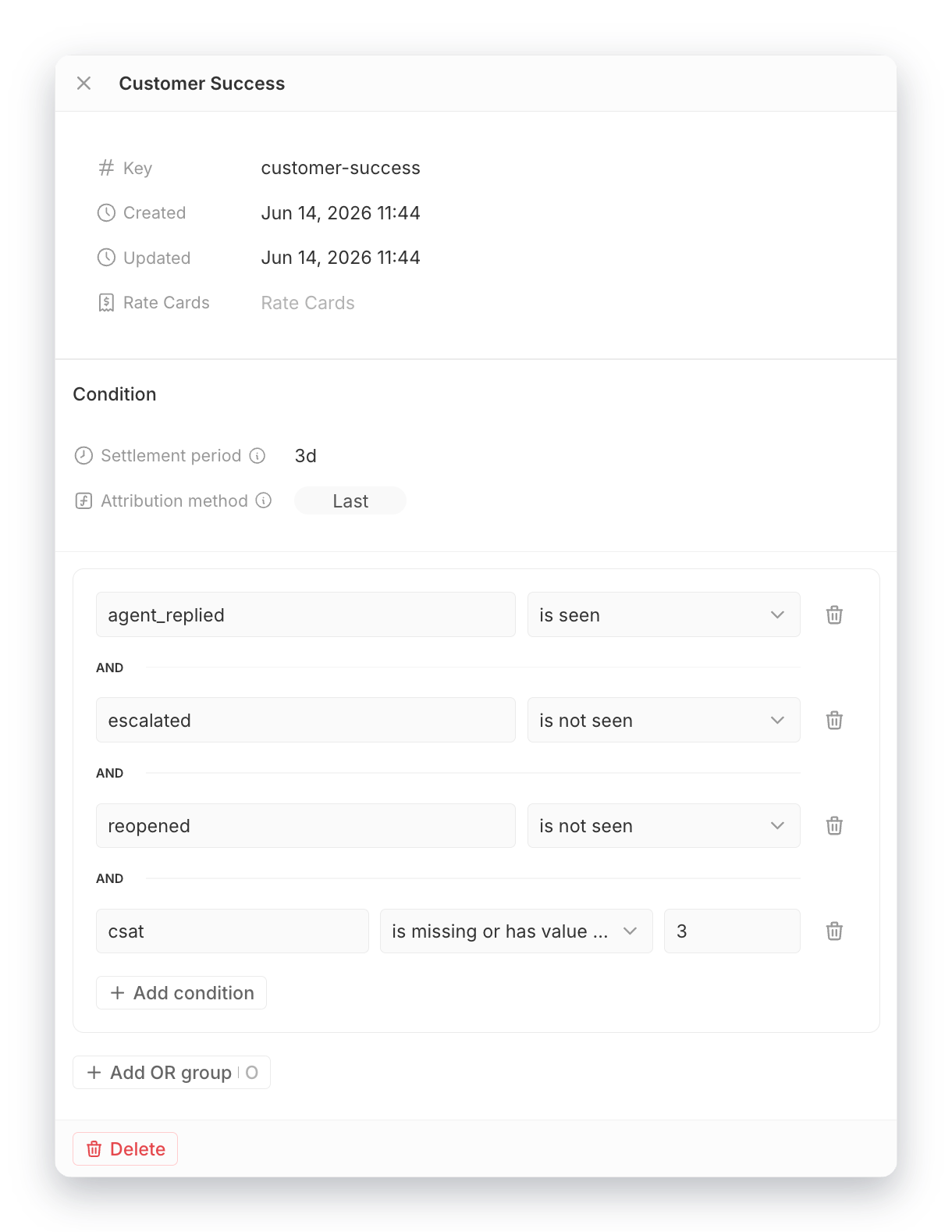
The contrast with input-based pricing is stark:
| Factor | Input-based pricing (usage/tokens) | Outcome-based pricing |
|---|---|---|
| Billing trigger | Resources consumed (API calls, tokens, minutes) | Successful, predefined result (a resolved ticket) |
| Impact of efficiency gains | Revenue per task decreases | Profit margin per task increases |
| Value alignment | Aligned with resource consumption | Aligned with the customer's success |
| Vendor risk | Low. The customer bears the cost of inefficiency | High. The vendor absorbs the cost of failed attempts |
| Ideal for | Infrastructure, APIs, early-stage products | Mature agents delivering tangible business results |
Navigating Implementation with Hybrid Models
While pure outcome pricing offers perfect alignment, it introduces operational challenges. The primary hurdle is verification. Defining a successful outcome requires binary, unambiguous metrics that leave no room for dispute. Was the lead truly qualified? Was the customer's issue fully resolved? Any ambiguity turns into a billing dispute later.
This is where hybrid pricing offers a pragmatic path forward. A hybrid approach combines a stable, recurring base fee with a variable component tied to successful outcomes. The base fee covers foundational costs and provides predictable revenue, absorbing the variance in compute costs. The outcome-based portion ensures you are still rewarded for delivering tangible value. This balanced structure is quickly becoming the default for builders who need both predictability and value alignment.
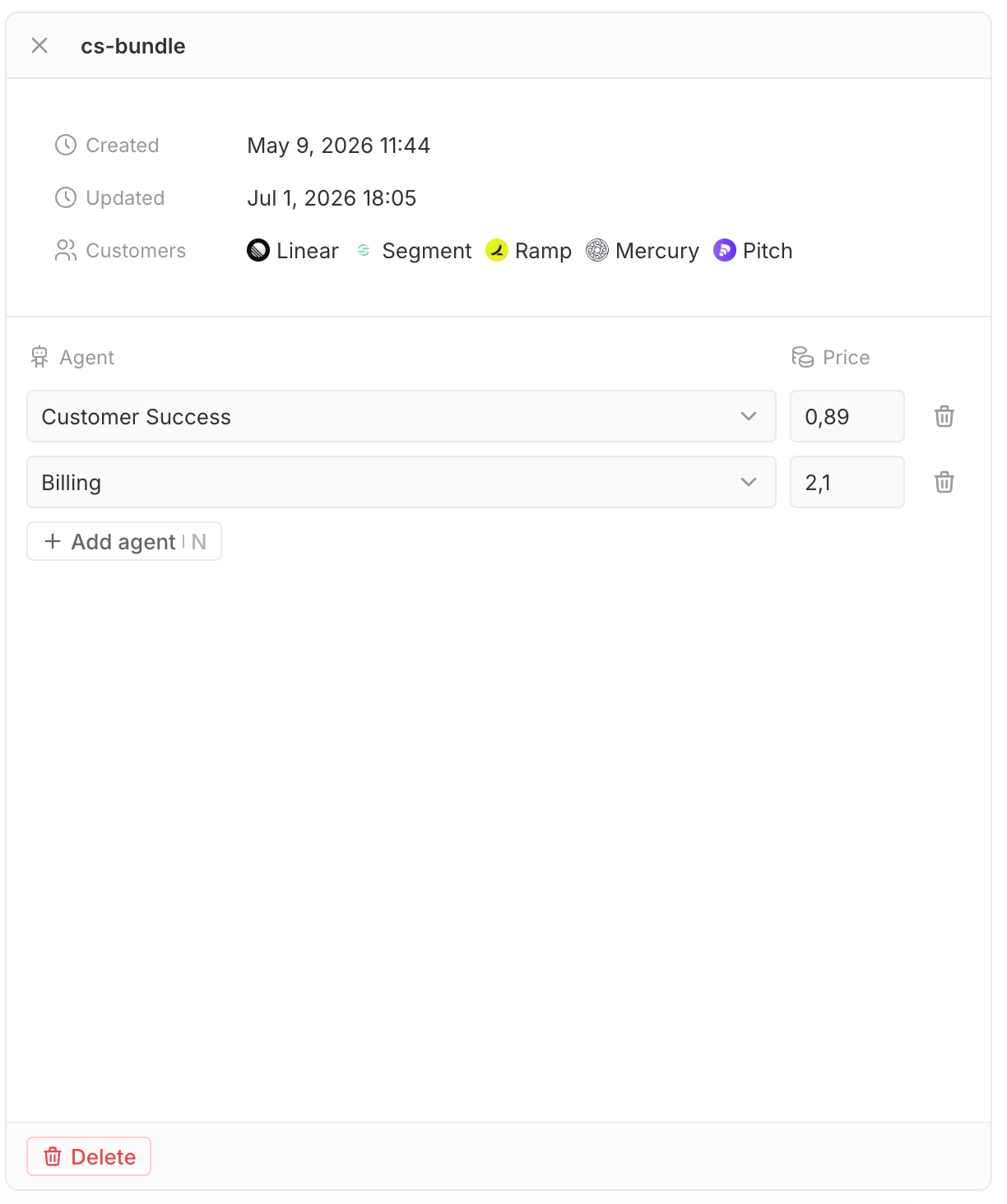
Hybrid pricing also means different customers get different terms. Rate cards make that manageable. Each customer gets a card that maps agents to prices, so the same outcome can carry a different price per customer without forking your billing logic:
Model Your Roadmap Before You Price It
Deciding how to price an AI product should not be a guess. Before committing to a model, project how your revenue changes as your agent improves. Take your roadmap and model a scenario where the product becomes twice as efficient at its job. Under a usage-based model, revenue declines. Under an outcome-based model, margins improve. The exercise takes an afternoon in a spreadsheet and it settles the argument with data.
It also does more than validate a pricing strategy. We have all been in meetings where a product improvement is questioned because of its potential impact on short-term revenue. A clear projection turns that conversation around by showing that efficiency gains strengthen the business instead of weakening it.
Building a Future-Proof Monetization Strategy
For AI agents that deliver tangible business results, pricing the input is a flawed model that punishes efficiency. As your product improves, your revenue should not shrink. The solution is outcome-based and hybrid models that align your revenue directly with your customer's success. This shift turns product improvements into margin gains and creates a business model that rewards innovation.
Treat pricing as a core part of product design, not a commercial afterthought. Your billing should reflect and capture the value your agent creates, so that as your product gets better, so does your business.
witn is billing infrastructure built for exactly this. Define the outcome as a condition. Send events as the agent works. The charge settles when the condition holds through the settlement window. Read the docs to see how it works.
More from the blog
How to Test Your Outcome Pricing Model Before Launch
De-risk your move to outcome-based billing. This guide shows AI agent builders how to simulate pricing against historical data and forecast revenue.
witn vs Orb
Compare witn and Orb for AI agent billing. Where usage-based metering fits, where outcome-native billing wins and how to choose for your product.
Metronome Alternatives After the Stripe Acquisition
Stripe acquired Metronome in January 2026. Here are five alternatives for AI billing, from usage metering to outcome-based billing and how to choose.